Amanda R – Puglia, Italy
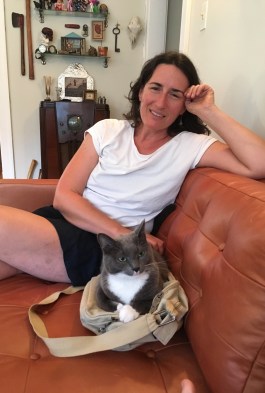 I was in the Peace Corps in Tonga. When somebody dies, they keep them in bed for three days and everybody comes by, and you sniff them. The Tongan “kiss” is where you get your cheeks close and you sniff each other. Cemeteries are this place where people go and have picnics. There’s a big pile of sand with all of these plastic flowers and they’re constantly decorating there. That’s where they celebrate on holidays. There’s not some association with ghosts. Our mutual friend Maria in Sarajevo explained to me that in the Balkans, they also don’t believe in ghosts. Cemeteries aren’t considered scary or negative.
I always wanted to live in a country that wasn’t Christian mostly because of death. Like what’s it like to be in a Buddhist country during death? And I worked in Thailand after the tsunami in 2004 and I was really interested in understanding how if you’re reincarnated into something else what is this grieving process going to be like? But Buddhists, at least in Thailand, believe that ghosts are a really serious thing. If you don’t have the body to perform the ceremony, they believe that the ghosts wander. So, after the tsunami, people were in constant search of the bodies because they felt like all of these souls were out there.
Ultimately, among all of these cultures, I think that people grieve the same. That was my feeling. There’s no kind of comfort. There can be means of trying to find comfort, but we’re all human and we all grieve. A funeral is a party there, too. But if they couldn’t find the bodies, they were just tormented. The village I was in, 3000 people died. They would posters everywhere of bodies found, but it was hard to identify them.
The Thai don’t want to burden others with sadness, to they’d say something like “I lost my sister or I lost my son” and they’d be smiling. And you can’t act sad, so I’d go home and just lose it. I realized I just can’t do relief work in that way because I can’t handle it emotionally. I was there for six months. We were there three months after the tsunami.
I have this memory of my grandparents, we would look through gravestone catalogues together. I went with them when I was like 7 and help them pick them out. I guess being in places where it’s been more celebratory has made me think of things differently. Like I mentioned in Tonga, there was a lot of sadness and wailing, but it was also a party. I had never thought of it that way before.
[Despite all of this] I haven’t thought about what I want for myself that much. But I want a green burial where I just decompose into the earth. I would want to be put wherever the person who was my family at that time wanted me. It doesn’t matter to me. I’d like people to be able to come together who haven’t been together in a long time. Which is kind of sad. Don’t you have this dream that one day you’ll finally have the time to be able to be with all of your friends at the same time, but it never happens because you have people all over the world that you love? Even at a wedding, the person getting married never actually has the time to sit with all of those people. You have to wait until you die.
Basics:
Age: 43
Religious Affiliation: Grew up Baptist, “taking friends to church to save their sorry souls.” Stopped going to church at around 16 or 17.
Occupation: Architect, olive oil maker, restorer of vernacular stone homes (coordinates stoneworkers “wallers” in Southern Italy)
Location: Puglia, Italy
Song recommendation: Lucinda Williams’ “Fancy Funeral”